Here’s to Brutal Beta Readers!

Okay, maybe not brutal, but definitely honest.

I’ve been working on my current WIP for quite a while now. I had it about half done with a fair bit in current works. I know the ending, more or less. But I really, really wanted some solid feedback. I knew there were some issues but I wasn’t sure exactly what they were, and until you know what the problem is, well, you can’t fix it, now can you?

I love my friends, but I wasn’t getting the kind of feedback I needed. It’s nice to hear “this is good!” but that doesn’t get you very far in fixing stuff. So I went to one of the writer boards on FB and found someone willing to work with me. And that was good!

Comments came in. Some good, some less so. Of those I think some had to do with personal style and taste; I logged those for further consideration and went on to the next comment.

And this paid off big time.  SOLID critique, at last! Some pointed at something I was aware of, and I will address that when I figure out how… But that issue pointed at something else we hadn’t gotten to yet – and here’s where I struck gold with my beta reader!

One piece of advice I see in writer advice is “Kill Your Darlings.” What that means for you non-writerly types is that no matter how good a scene is in the writer’s mind, no matter how perfectly you’ve crafted the words, no matter how fond you are of it – if it ain’t working, it’s gotta go.

I have a real darling right in the midpoint of the story, and it’s gotta go.

Really good fight between my Main Character and his nemesis. Good action. Snarky, pointed, nasty dialogue on my baddie’s part. A good death scene and a dying curse, leading to a real existential crisis in my Main Character! Angst! Woe! Friendly interventions!

Um, do you see the problem here?

Here it is: You can’t kill off your main villain in the middle of the book. And the backup villains, the leaders of a foreign government, are taken out by someone other than my Main Character in what amounts to a Deus Ex Machina.

GINORMOUS no-no.

Now, I *did* know these were problems, but sometimes  ya gotta write something to get it out of your head so you can go on to write something else, and that’s what these were. That’s how they wrote themselves.

So, my darlings, you’ve got to go.

Piece of writerly advice: never, Ever, NEVER delete scenes entirely and erase them from your computer! Instead, you cut them out and paste them into a new document and save them. That was very likely some of your best writing, that’s why it was your Darling! Thing is, you may not be able to use it in a later scene, or even in the same work. But you MAY be able to recycle pieces/parts later, or somewhere else.  Or use it as inspiration for something else. Creativity, like energy, is not wasted.

Meanwhile, back at the ranch, I’m taking a break to do some of what I call “writing-adjacent” work. That’s everything that has to do with writing that doesn’t actually involve, you know, the actual “writing” of a story. Research, character studies, stuff like that. In my case, I’m going back to basics. REALLY basics – story structure, outlining, that sort of thing. Reading articles from sources I know and trust.

One of my friends years ago told me that I was “giving my life away to figuring it out.” But sometimes a writer’s gotta do what a writer’s gotta do, and so I’m a-gonna do it.

And this book will be all the better for it.

Best. Advice. Ever.

Daily writing prompt
What’s the most profound piece of advice you’ve been given? Did you take it?

The most profound, useful, and freeing advice I’ve ever found was from Neil Gaiman:
“In your first draft, write down everything that happens in your story. Then in your second draft, make it look like you knew what you were doing all along.

Yes, I’ve taken it and run with it like a cat that stole the fish right off your plate! It’s allowed me to stop obsessing about what Act I’m in, what scene goes where, does this belong in the story at all or is it too much… Now I can just write everything that happened, and let God — er, me — sort it out later.

Why I Do What I Do

~ And maybe why you should care…

Ran across a blog post today by Kimberly Grabas on Your Writer Platform. The article is about marketing your book and building your writer platform.

2 Must-Dos to Make Your Book Marketing Infinitely Easier

I read it through, and was all set to comment when I tripped over my own response from back in 2013! <blush> Didn’t recognize the article, didn’t remember it at all ’til I saw my own icon…

I was just as impressed on this read-through as I had been on the last, but this time I went farther than before. This time, I had the time to form some answers to the questions Kimberly had posed.

Her questions were based on Simon Sinek’s book, Start With Why – specifically, his concept of the Golden Circle. Here are her questions and notes:

“People don’t buy what you do, they buy why you do it”. ~Simon Sinek, Start With Why
For the average writer, this is their Golden Circle:
What you do: write fiction, non-fiction, novellas, articles, poetry, web copy and so on.
How you do it: your difference from your competitors; in marketing speak, it’s your unique selling proposition, or what makes your work distinct from other writers in your field.
Why you do it:
o A purpose or belief. It’s why you get up at 5am to squeeze in your daily word count; why you write around your day job, family and other obligations; why you write, despite the pitying looks from new acquaintances when you reveal “I am a writer”.
o It is the meaning and message behind your work.
o The piece to the puzzle that you need to solve, that, once determined, eliminates the need to continually try to differentiate yourself.
Will your ‘why’ resonate with all possible audiences?
No. But those it does meld with will be your rabid fans, your community, your tribe.
Without clearly expressing why you are doing what you do, you are left with trying to prove your advantage or significance based on marketing tactics alone.

I thought about this for a while, as well as reviewing the comment I’d originally responded to, and came up with this:

What I do: I write stories involving people facing seemingly impossible odds.
How I do it: I do it by writing stories of people who find within themselves the strength to persevere, even if they see no hope of winning.
Why I do it: I do this because my stories show that G. K. Chesterton is right – that monsters exist, but also that monsters can be killed. That if one person can make it through, then someone else can make it through. My message is that of empowerment.

My best stories have started from dreams I’ve had. Dreams from which I’ve woken with a feeling that did not let me go – not that day, nor for days afterward. Dreams that gave me a character and a situation, but no other information other than the knowledge that I wouldn’t be able to leave it alone until I started writing and found out the rest of the story.

I guess I might call them “stress dreams,” because they seem to come in my life when I am under a great deal of stress. Perhaps it is the Universe – or my Muse – telling me “It’s going to be alright. Just hang in there and keep on the way you’re going, you’ll make it through.” And usually I do. Maybe because I stop obsessing about my stressful situation and start focusing on the story I’m discovering? Who can say?

But the point remains ~ my characters are battered and brutalized by the villain and by the life around them. They face horrible situations and impossible odds. They often cannot see their way through – but they absolutely refuse to stop, because they know that if they do, worse will happen. They know, deep in their bones, in the core of their soul, the truth of the quote attributed to Edmund Burke: “The only thing necessary for evil to triumph is for good men to do nothing.” And so they stand up, one more time, bloody but unbowed, and they stand between. They stand between evil and the innocent, because they cannot do anything else. They stand between, knowing that it may be “over my dead body” – but promising that they will by God take an honor guard.

And because they do, others come to join them. To help them. To empower them – and thus, to empower themselves as well. Because that kind of courage sets an example, and draws others to their cause. And soon, my characters find that they’re no longer alone, that they’re not Sisyphus, pushing a boulder up hill. Soon, there are others adding their strength to theirs. And that is how they win.

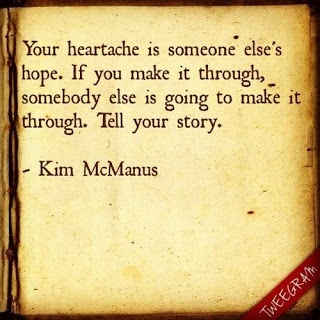
I write, because as Stephen King says, I can’t not write. But what I write, and why I write – that comes from a quote by Kim McManus.

Tell Your Story

If this resonates with you, I hope you will check out what I’ve written on this blog under the header “my words.” And I hope you’ll let me know what you think.

‘Cause okay, yes – I admit I could use the encouragement…  😉


What Do You See, What Do You Know?

They say that writers see things differently than other people. I don’t know that that’s true.

I don’t think that we see things differently. I think that we SEE. That maybe we pay more attention to what we see, that we pick up what we see, and handle it, and look at it from different angles. We don’t see differently, we see more. We look deeper than the surface. And then we apply our own observations, our own interpretations, our own emotions, as touchstones and litmus tests and whatever other tests to see if they look real, to see if they feel true. If they feel TRUE.

I haven’t ever had a “love of my life.” But I’ve loved. I’ve loved my parents, and I’ve loved my friends, and I’ve loved my cats. And yes, a special someone or two. I’ve read hundreds, maybe thousands, of books where people love and are loved. I’ve watched TV shows and movies and plays. And I’ve seen my friends go through the motions and the emotions. The highs and the lows and the devastating pain of losing a loved one. And so I know I can write about love. Because even though I have never felt that particular love in my own self, my heart knows how that feels because through my watching and my testing and my simply living—I encompass all these things.

They say “write what you know.” But oh, we know so many things that we have never experienced in our own selves. We are rich in experiences that have happened to others. From books, from TV, from movies, from plays. And in those things and the things we have experienced are the seeds to write what we have not.

I have never gone skydiving, but I have leaned against the wind in a storm and felt it hold my body up when I should have fallen. Felt it take my breath away even as it fills my lungs with elation. I have felt my hair whip across my face driving in the car with the top down. So when I see someone leap out of an airplane and spread his arms like wings I know what he is feeling. And if I know it, I can show it.

Write what you know. But remember that you know more than you think.